Wealth, power, and impunity
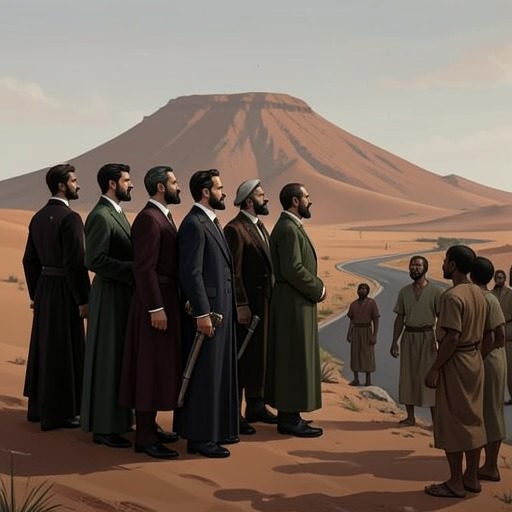
The ForgivenWealth, power, and impunity names the imbalance that lets affluent foreigners move through local life as welcome employers and unsettling outsiders, while a dead poor boy can be treated as an administrative inconvenience. The novel does not reduce that imbalance to money alone: it joins material privilege to British solidarity, colonial assumptions, and the practical power to negotiate. The visitors’ wealth brings visible benefits, but when their world meets the boy’s death, the disparity in whose identity and fate matter becomes stark.
Visitors, money, and local advantage
The foreigners are called visitors, a name that carries the expectation that they will eventually depart as abruptly as they arrived. Their wealth is acknowledged even by people who find their habits strange or demonic. They hire servants and staff, pay extravagantly, and do not work them very hard. Their presence brings cash and beautification to the ksour, benefits that coexist with suspicion rather than dissolving it.
That ambivalence is particularly clear in the old residents’ response to Dally Margolis and Richard Galloway. They regard the men’s relationship with dry disgust, yet privately admire their cosmopolitan style and the purchasing power behind it. Oranges arrive from Spain, butter from a single shop in Paris’s 8th arrondissement, and drinking water from Meknes. These specific imports make wealth tangible: the visitors can summon goods from elsewhere, while the local community receives wages and improvements from their spending. Economic dependence and cultural disapproval therefore occupy the same space.
The dead boy and unequal recognition
After the collision, the boy lies in the garage without identification or even a dirham in his pockets. David Henniger and Richard Galloway recognize that they are both English and feel a bond of complicity against the people they understand as the other side, especially Muslim officials who do not drink. Their unease briefly reaches the harder question of whether the dead boy belongs within that imagined division. They do not even know his name. The absence of identification makes his vulnerability concrete, while the foreigners’ shared national identity gives them an immediate point of solidarity.
Hamid understands enough of their conversation to recognize their fear of Moroccans. He considers warning them that they are little trusted by the local population and is inclined to help, but he also takes some interest in their sudden helplessness. His divided response complicates any easy picture of locals as either passive beneficiaries or a unified opposition: he sees the foreigners’ anxiety clearly and retains his own judgment about whether to assist them.
The boy’s poverty becomes an explanation for doing little. Richard tells David that the boy is a nobody from a distant village and that nobody knows who he is, presenting these facts as a reason there is nothing to be done. David asks what they have done, but Richard insists that he is only stating a fact. The exchange shows how social invisibility can be converted into apparent administrative inevitability: a lack of money, name, and known connections makes the victim easier to dismiss, not less deserving of attention.
Money as a proposed exit
The corpse remains in the air-conditioned garage overnight after Yassine Benihadd declines to take it away, saying that his post has no morgue and arrangements must wait until the next day. A man keeps vigil beside the body, praying beside a pot of mint tea. The comforts of refrigeration do not undo the larger failure of recognition; for David and Jo Henniger, the body’s presence makes their responsibility impossible to avoid. The narration’s judgment that they are assassins places moral blame beside the official delay, rather than allowing procedure to settle the question of responsibility.
Richard’s first practical answer to the escalating tension is payment. He anticipates telling David to pay the man and make him go away, and says exactly that when David arrives. David refuses, arguing that payment is not appropriate after an accident. Their disagreement is not simply between conscience and cynicism: Richard treats money as a tool for ending exposure and restoring control, while David resists turning the death into a transaction. Richard’s proposal nevertheless reveals the advantage their resources give them. They can imagine a payment as a way to close a crisis that the dead boy’s poverty has made easy for others to leave unresolved.
Colonial reflex and negotiated power
Under pressure, David’s anger hardens into a colonial outlook. He thinks white people are being blackmailed by Muslims, resents what he sees as white submission, and imagines the villagers as fundamentally unlike himself. The narration connects this reaction to the officer-class inheritance of his grandfathers, describing a reserve that falls away when David feels threatened. His claims about political correctness and racial hierarchy are presented as a revealing exposure of character, not as a neutral account of the people around him. Privilege here includes the confidence to interpret a demand as extortion while treating one’s own capacity to pay, leave, or command attention as ordinary.
Richard offers a different tactic, not a rejection of the unequal situation but a way to manage it. He advises listening to what people want and giving it to them, expecting the matter to be forgotten afterward. David, meanwhile, fears that visible weakness will invite further demands. Their exchange casts local negotiation through competing foreign assumptions: Richard’s transactional pragmatism and David’s defensive resentment. Both men treat money and bargaining as instruments in a struggle over control, even as the boy’s unrecorded identity remains the original fact their strategies cannot erase.
Across these episodes, wealth brings hospitality, imported comforts, paid labor, and room to maneuver. It does not guarantee that outsiders can control every consequence, as the foreigners’ fear and Richard’s diminishing sympathy for David make clear. But the boy’s anonymity and poverty sharply limit his standing, while his death becomes a problem the better-resourced men can debate as payment, paperwork, and inconvenience. The concept’s force lies in that contrast: money can soften the visitors’ circumstances and supply them with exits, whereas the poor victim’s absence of money and recognition helps make his loss easier to contain.